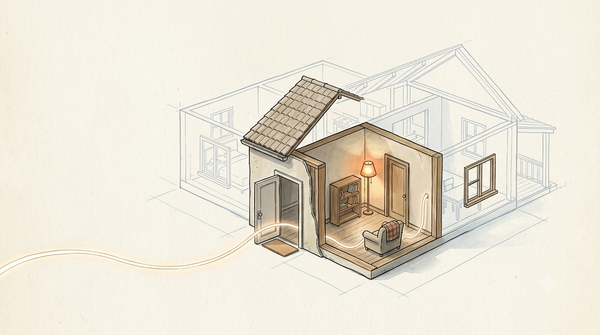
I Said I Wouldn't Make It a Framework. Then I Did.
Markdown Mind Part One - A week ago I closed a post by refusing to package my AI-memory setup as a framework. Then I spent the next days building one. This is me squaring those two things — and why a playground is not a product.

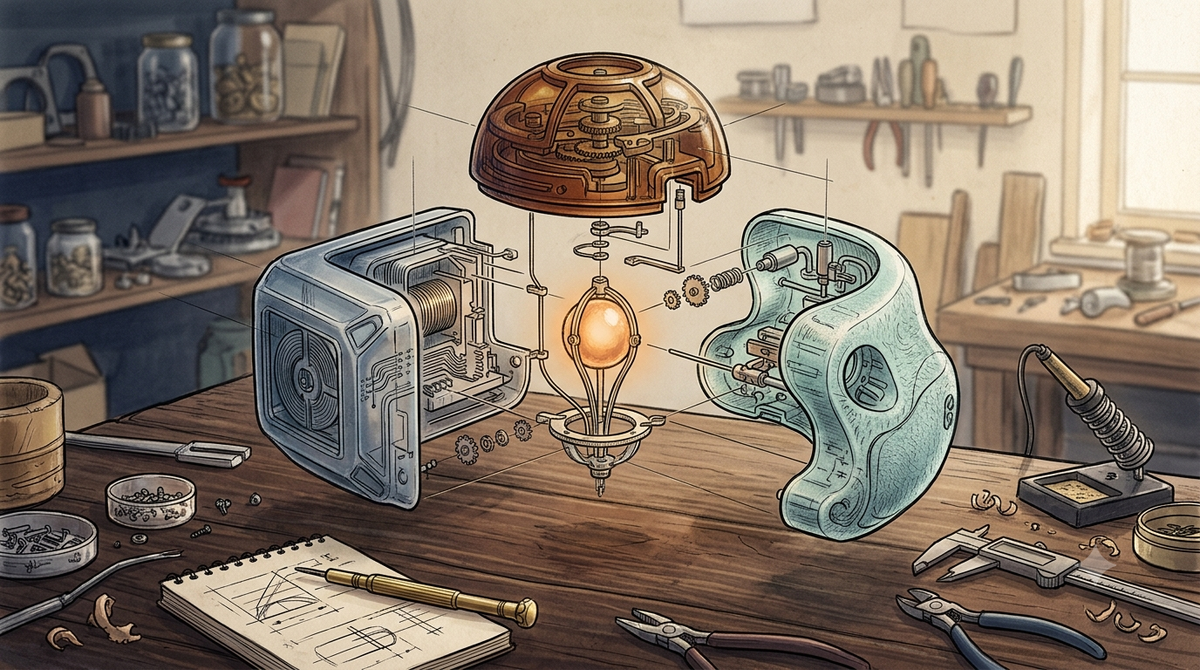
A week ago I closed a post with a line I meant:
"If I sold it to you as a framework I would be doing the exact thing I am trying to get out from under."
That post was about moving my AI's memory out of other people's products and into a folder of Markdown I own. The line was the whole spine of it - the moment you package a thing and sell it as a framework, you have rebuilt the vendor lock-in you just walked away from, except now you are the vendor.
I still stand behind that line. I also spent the weeks after writing it building a framework.
This is me squaring those two things. They are not actually in conflict - but you would be right to make me prove it before you believe that.
Here is what happened in between. I kept building the same system. By hand. Again.
Not once. Four times, if I am honest about the count. The personal one from that post, spread across all my machines. A second one for my work knowledge base - a domain that has to stay factually correct or it is worse than useless, because a confident wrong answer is more dangerous than no answer. A third, from a completely blank folder, built sitting next to someone who does not write code and never will. And pieces of a fourth, for friends who saw mine and wanted the same thing without the month of fiddling that got me there.
Every time I started from nothing and rebuilt the same bones. Same numbered folders. Same two-layer split. Same propose-before-you-write rule. Same onboarding handbook an agent reads before it is allowed to touch anything. I was hand-copying my own conventions from one setup to the next like a man who has not yet been told the photocopier exists.
There is a point where noticing you have done a thing four times stops being a fun observation and becomes the actual signal. The repetition was the tell. When the same skeleton falls out every single time, regardless of who the system is for, that skeleton is trying to tell you it wants to be written down once. Refusing to package it had stopped being humility somewhere along the way and quietly turned into waste - mine, and the time of everyone who asked me how I did it and got a forty-minute monologue instead of somewhere to start.
So I want to be precise about what I built, because the word "framework" is going to do some damage here if I let it walk around unsupervised.
I did not want to ship a product. I wanted two things. An on-ramp, so the next person - or the next me, six months from now, staring at an empty folder with no idea where the first file goes - does not start from zero. And a place to keep the learnings. All the small "oh, that does not actually work" corrections each rebuild taught me, which until now lived nowhere except my own head and got re-derived from scratch every time. Four builds' worth of scar tissue, written down once so nobody has to earn it the slow way again.
That is the whole ambition. Not "here is the answer." Closer to "here is where I would start, and here is what I already got wrong, so you can skip those parts and go make your own mistakes instead."
When I finally laid the four systems side by side, the structure did not need designing. It fell out on its own.
Some things were identical in every single version. The two-layer memory split, the write-only-after-you-propose rule, the onboarding-over-configuring idea, the numbered shape of the folder. Those never moved, no matter who the system was for. That became the kernel - the part you take whole and unedited, precisely because it earned its place by being true every time.
Then there was the part that changed with every build. One person on many devices is simply not the same problem as one person guarding a knowledge base that has to stay correct, and neither of those is the same as starting from a blank folder next to a non-technical person who needs the guardrails to be gentle and impossible to miss. Those differences are real, and they cluster along a small handful of axes. Those became presets - right now there are three, one for each real system that taught me something worth keeping. You take the whole kernel, pick the preset closest to your situation, and then make it yours. What is actually inside each of them is what the rest of this series is for. This post is only about why the thing exists at all.
Now the part that keeps the July 25 line intact, and I need it to land clearly, because it is the actual point and not a footnote.
This is not a product. I am not selling you anything, and I am not telling you to adopt it whole and trust it. My honest recommendation is to treat it as a playground - something to poke at until you understand what you actually need, and then either build your own from scratch or bend mine until it fits your life instead of my life. The value was never the files. The value is getting to see a working example, so that the empty folder stops being the thing that talks you out of starting.
That is the reconciliation, and it is not a dodge. In July I refused to hand you a framework and walk off as if the framework were the answer. I still refuse that. What I shipped is not an answer - it is a head start with the mistakes already marked on the map. The difference between a product and a playground is whether you are meant to trust it or to take it apart. This one you are meant to take apart.
It lives on my own git server for now, not public yet. Partly because it is genuinely not ready. Mostly because I want this series to explain the thinking before anyone copies the files - since copying the files without the thinking is the exact failure mode I have been circling this whole time.
So that is Part 1. The why, and the confession that I did the thing I said I would not do, for reasons I think hold up.
Where this goes next: the different shapes the same system takes depending on who it is for, the setup that gets you from an empty folder to working memory in roughly one prompt, and the unglamorous lessons from hardening the thing once real use started grinding on it. I will try not to oversell any of them. If the last three months taught me anything, it is that the folder was never the interesting part - and neither is the framework. What you do with it is.
Markdown Mind Part One