The instruction a weak model can't misread
Markdown Mind Part Four - It behaves this well now because it behaved badly first. I hardened the installer by running it through a deliberately weak local model — and every fix collapsed to the same move.
Markdown Mind Part Three - You download a folder, open it in your agent, and type one sentence — and instead of running a form, the installer onboards you the way the finished system will always behave. The setup is not configuration; it is the first live demo of the thing you are installing.
Markdown Mind Part Two - The same eight ideas that run my power-user setup also run a system for someone who never wants to see a file path — and a knowledge base a team governs like production code. One kernel, three shapes."
Markdown Mind Part One - A week ago I closed a post by refusing to package my AI-memory setup as a framework. Then I spent the next days building one. This is me squaring those two things — and why a playground is not a product.
For about a year, everything my AI assistants knew about me lived inside other people's products. So a few weeks ago I moved all of it into a folder I own — plain Markdown in my everyday Obsidian vault, no vendor — and the model underneath became swappable.
Every budgeting app I have tried failed for the same reason. It was built for the average household. So my wife and I built the one for ours - selfhosted, agent-native, gamified.
I built an eight-skill personal AI system in one evening. The most useful thing it produced, three hours later, was a verdict telling me to stop building.
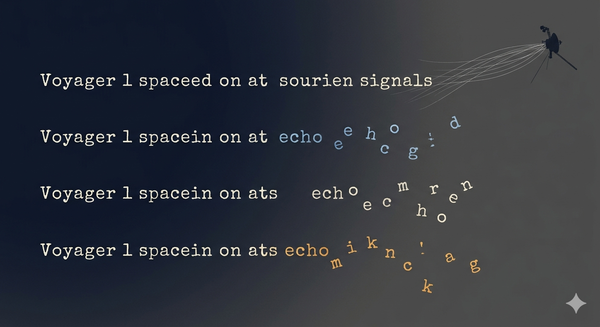
Three runs of LLM Chinese whisper with everything identical except the random seed. Retention rates: 85.5%, 87.6%, 88.2% — close enough to call it consistent. Then I looked at what broke in each run. Three completely different semantic failures. The error rate is reproducible. The topology is not.
I ran a experiment to find out if a growing memory context makes AI more sycophantic. The answer wasn't what I expected — and the strangest finding came from a lie I hid inside the model's own knowledge graph.
Two local LLMs, ten turns, no external ground truth — perfect conditions for collaborative hallucination. They declined. I'm still not sure what to make of that.