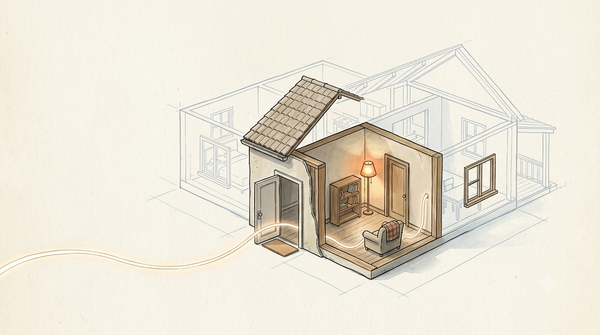
Building nothing more this week
I built an eight-skill personal AI system in one evening. The most useful thing it produced, three hours later, was a verdict telling me to stop building.


I built an eight-skill personal AI system in one evening. The most useful thing it produced, three hours later, was a verdict telling me to stop building.
Let me back up, because the timeline is the whole point.
On a random thursday evening this july, roughly 20:00, I sat down with Claude Code and built or reworked seven skills in one go — a challenger that stress-tests ideas, a weekly review, a publishing pipeline, a body log, a knowledge-base gardener, a guided journal, an evening router. Add the mentor skill I had reworked the night before, and that made eight. A little personal OS. Each one got its own memory folder in my Obsidian vault: ledgers, decision boards, commitment lists. It felt like progress. Building always does. That is exactly the problem.
If you build these things too, you know the feeling. Building compiles instantly. You write a skill, it exists, the folder is there, the commit is green. Using it takes discipline and gives you uncomfortable answers back. This is why side-project graveyards exist — not because people can't build, but because building is the easy dopamine and using is the hard one. I have a graveyard of my own. My old daily notes: three entries between April and June, then silence.
So I tried to design the trap out of the system from the start.
The journal skill exists because the challenger, that same evening, made me figure out why the old notes died. My first guess was the typing effort. Wrong. The thing that actually killed it was the blank page — sitting down to nothing and having to invent a first sentence. So the journal has exactly one commandment: never a blank page. And the challenger attached a kill criterion before it let the idea through — fewer than twelve entries by August, and the whole thing goes back to the challenger instead of quietly becoming a second silent journaling graveyard.
That is the pattern I was reaching for across all of them. Not "encourage me." The opposite.
- The publishing pipeline has an honest gauge: if two or more drafts pile up unposted, stop drafting and take the why to the mentor. Writing draft number three for the pile would just be rubber-stamping the real problem.
- The body log is explicitly forbidden from building tracking infrastructure. Measurement tooling is the classic procrastination magnet — you build the observatory instead of looking at the sky.
- The mentor has a standing rule to refuse analysis-as-progress.
You can see what I was worried about. I don't fully trust myself to notice, in the moment, that I am procrastinating by building. Nobody does — building feels like work, and it produces an artifact you can point at. So the honest move is to make the system the honest party instead of me. Agree the kill criteria before the greenlight, when you are still cold. Count outcomes, not artifacts — posts posted, entries written, not skills created. And have a recurring review that is allowed to say the word "stop."
Which brings me to 23:11 the same night.
About three hours after finishing the suite, I ran the weekly review for the first time. Its job is to look at the week and grade it honestly, including grading the system it is part of. Its verdict: the suite was built but barely used. Eight skills against almost no usage is an "observatory risk." Two build-until-midnight nights back to back, directly before a five-day work trip. Recommendation: build nothing more this week.
So the first real output of the system was to call its own creation the procrastination it was at risk of becoming.
I want to be fair, because the review was fair. It also noted the counter-evidence: one commitment I had made through the mentor — booking an independent mortgage-financing consultation — was actually kept. So not everything that evening was displacement activity. But the headline stood. I had spent two nights building tools to be productive, which is one of the oldest ways there is to avoid being productive.
An AI that only ever encourages you is a sycophant with extra steps. It feels great and it costs you months. The configuration that is actually worth having is one that is contractually allowed to tell you no — that you agreed, in advance and in writing, could look at what you did and say "this was avoidance." I did not want a cheerleader. I wanted a review that could ruin my evening with one honest paragraph, and it did.
Here is the part that keeps this from being a tidy little parable, because tidy parables are usually a lie about the size of the thing.
The days after, I actually used the skills instead of extending them. Journal entries were created — no blank page, so no excuse. Body logs. An execution-debt review that cleared seven dangling life-admin items in a single morning, the kind of small stuff that had been rotting on the list for months. The system worked, but only once I stopped feeding the build reflex and started feeding the boring one.
And yes — two days later I built one more skill. An autobiography-capture thing. So much for "build nothing more." But that one earned its place within hours: twenty-six memory fragments and one fully written story captured on day one. Used before it could become an artifact.
That is the actual lesson, and it is less clean than "never build." Building is fine. Building is fun. But usage has to lead, and I have proven often enough that I can't be trusted to judge that in the moment — so now the system audits it instead of my good intentions. The most valuable skill I wrote that evening is the one that grades the other seven and is allowed to tell me I wasted my time.
Honesty compounds. Even when the honest party is a review job you wrote yourself, at 23:11, that turns around and tells you to go to bed.